Why Billet Rotor Pairs Matter for Your Supercharger's Power and Longevity
When someone asks about billet rotor pairs, they usually get one of two answers: “it’s marketing” or “it’s mandatory.” Neither is right. The truth is that billet rotors solve a specific problem — thermal expansion and tolerance drift at sustained high-load operation — and that problem only becomes relevant at a certain power level.
Here’s what the upgrade actually does, why it matters, and when to spend the money.
What Are Supercharger Rotors?
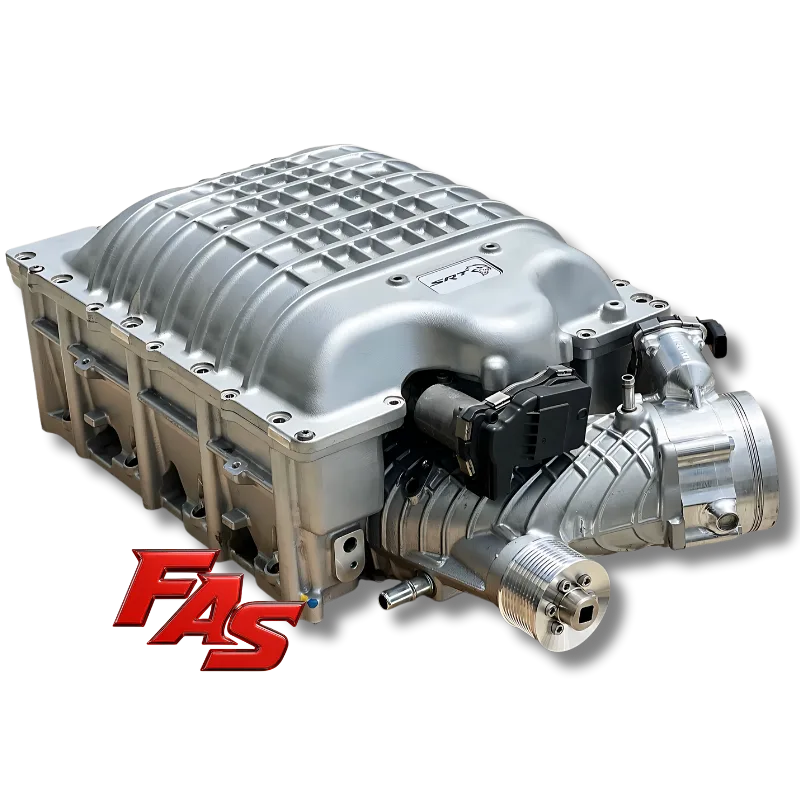
The rotors are the heart of a positive-displacement supercharger. In a Twin Vortices Series (TVS) blower like the Hellcat 2.4L, two four-lobe helical rotors spin in mesh inside a precision-machined aluminum housing. As they turn, they trap air between the rotor lobes and the housing wall, then push it toward the discharge port under pressure.
The power output of the supercharger is directly tied to how precisely those rotors fit inside the housing:
- Too much clearance: Air leaks back past the rotor tips (blowback), reducing boost efficiency
- Too little clearance: Rotor tips contact the housing under thermal expansion (catastrophic failure)
- Just right: Tight enough to minimize blowback, loose enough to survive heat
The manufacturing process used to make the rotors determines how precisely that clearance can be held — especially as temperatures change.
Cast Rotors: How They’re Made and Where They Fall Short
Factory Hellcat rotors are die-cast aluminum. Die casting pours molten aluminum into a steel mold and lets it solidify under pressure — a fast, cost-effective process that produces consistent parts in high volume.
The limitation: cast aluminum has higher porosity and less consistent grain structure than billet. The material properties vary slightly from part to part, and more importantly, the thermal expansion behavior is less predictable than a billet part machined from solid bar stock.
At factory power levels and normal operating conditions, this doesn’t matter. The rotor-to-housing clearances are spec’d with cast material properties in mind. The blower runs within its thermal range. Everything is fine.
Where cast rotors start showing limits:
- Sustained high-boost operation — more boost = more heat = more thermal expansion. If the expansion rate differs from what the housing clearances were designed around, you get tip rub.
- Aggressive pulley reductions — a smaller upper pulley spins the rotors faster, generating more heat per unit time.
- Back-to-back high-load pulls — track use, dyno sessions, repeated hard launches. The blower never gets a cooling-off period.
- Rotor tip coatings wearing thin — factory rotors use an abradable coating at the tips. Once it wears, the tolerance is the aluminum itself. Cast aluminum is softer and less uniform than billet at that final layer.
Billet Rotors: What’s Different
Billet rotors are CNC-machined from a solid piece of 7075 or 2024 aerospace-grade aluminum bar stock. The process is slower and more expensive than die casting — but the resulting part is different in ways that matter for extreme applications.
Related Posts
Hellcat Supercharger Porting Explained: What It Does and When You Need It
If you're pushing a Hellcat, TRX, or Trackhawk past 700 whp, you've probably asked about supercharger porting — here's what it is & if it's right for you.
Hellephant C170 Engine: What It Is, What It Makes, and What It Costs
The Dodge Hellephant C170 crate engine makes 1,000 hp and 950 lb-ft from 426 cubic inches. What it is, what it costs, and what a complete build runs.
LT4 & Hellcat Supercharger Porting: FAS Porting Process, Gains & What It Costs
LT4 (C7 Z06, ZL1), 2.4L Hellcat TVS, and 2.7L IHI supercharger porting done in-house. Precision CNC port work, flow-bench verified, shipped back in 3–5 business days from Punta Gorda, FL.