Eaton M112 Supercharger: Complete Upgrade Guide (Rebuild, Porting & Performance)
The Eaton M112 is everywhere. Ford ran it on the SVT Cobra, the Mustang GT500, the Lightning, and a handful of other performance platforms across nearly two decades of production. GM used M-series Eaton blowers across the LS lineup. If you’re building a forced-induction vehicle on one of these platforms — or buying one already built — there’s a strong chance an M112 (or its close cousin, the M122) is sitting on top of your engine.
This guide covers what the M112 actually is, how it performs stock, what rebuilding involves, what porting does to it, and how to decide which service path is right for your build.
What Is the Eaton M112 Supercharger?
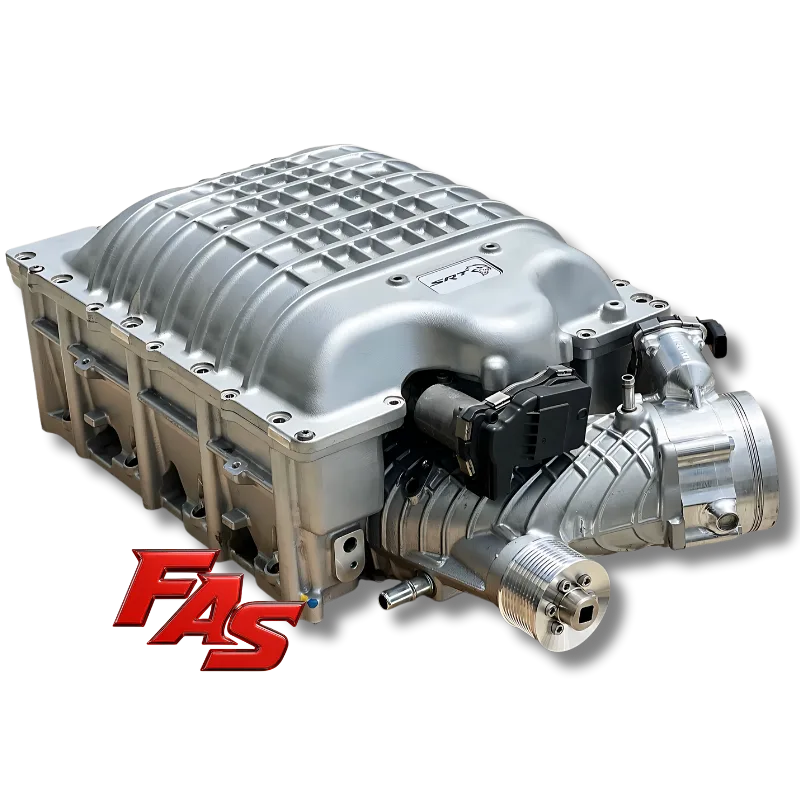
The Eaton M112 is a positive-displacement Roots-type supercharger with a 112 cubic inch displacement rating. It uses a pair of three-lobe twisted rotors to compress air and deliver it directly to the intake manifold. Unlike a centrifugal blower, the M112 builds boost immediately at idle and maintains a relatively flat boost curve across the RPM range — which is why factory OEM engineers chose it.
Key M112 specifications:
| Spec | Value |
|------|-------|
| Displacement | 112 cubic inches (1.84L) |
| Rotor design | 3-lobe twisted (Helix) |
| Maximum boost (stock) | 8–10 psi depending on application |
| Oil system | Integrated gearcase, separate from engine oil |
| Drive | Belt-driven via supercharger snout |
| Weight | Approximately 35–40 lbs (complete assembly) |
Common M112 applications:
- 2003–2004 Ford SVT Cobra (Terminator) — 4.6L 4V
- 2005–2006 Ford GT (modified M122 variant)
- 2007–2012 Ford Shelby GT500 — 5.4L 4V
- 2002–2004 Ford F-150 SVT Lightning — 5.4L 2V
- Various GM LS applications (crate blower kits)
The M112 vs. the M122
You’ll often hear M112 and M122 used interchangeably — they’re not the same unit. The M122 is the larger 122 cubic inch displacement version used on the GT500 and some GM performance applications. It physically shares the same rotor design and service methodology as the M112 but flows more air due to larger rotor volume.
The services covered in this guide apply equally to both units. When we say M112 below, assume it applies to M122 as well unless noted.
Stock M112 Performance Limitations
The M112 from the factory is built to OEM tolerances — reliable, quiet, and conservative. That’s a feature for a daily driver. For a performance build, it creates a ceiling.
The three main restrictions on a stock M112:
1. Snout restriction. The supercharger snout (the nose of the unit that houses the drive pulley) is the inlet path through which air enters the blower. Stock casting leaves significant material in the inlet bore — enough to meaningfully restrict airflow at higher RPM and boost levels.
2. Inlet port restriction. The inlet opening where air enters the rotor cavity has casting flash, a rough surface finish, and a conservative port shape from the factory. This restricts how quickly and efficiently air can enter the rotor pack.
3. Rotor clearance degradation. Over time and heat cycles, rotor-to-rotor and rotor-to-housing clearances open up. This increases internal bypass (rotor blowback), reducing effective compression efficiency. A unit with 40,000+ miles will not hold the same boost as a fresh rebuild.
Service Option 1: M112 Rebuild
A rebuild restores the M112 to factory-new internal clearances. This is the foundational service before any porting work.
What a rebuild includes at FAS Motorsports:
- Complete teardown and cleaning
- Inspection of rotors, housings, snout, and gearcase
- Replacement of bearings (front snout bearing, rear bearing, gearcase bearings)
- Replacement of seals and gaskets
- Coupler inspection and replacement as needed
- Rotor clearance measurement and verification
- Oil fill and reassembly to spec
Related Posts
Hellcat Supercharger Porting Explained: What It Does and When You Need It
If you're pushing a Hellcat, TRX, or Trackhawk past 700 whp, you've probably asked about supercharger porting — here's what it is & if it's right for you.
Hellephant C170 Engine: What It Is, What It Makes, and What It Costs
The Dodge Hellephant C170 crate engine makes 1,000 hp and 950 lb-ft from 426 cubic inches. What it is, what it costs, and what a complete build runs.
LT4 & Hellcat Supercharger Porting: FAS Porting Process, Gains & What It Costs
LT4 (C7 Z06, ZL1), 2.4L Hellcat TVS, and 2.7L IHI supercharger porting done in-house. Precision CNC port work, flow-bench verified, shipped back in 3–5 business days from Punta Gorda, FL.