Best Cold Air Intake for 6.7 Powerstroke: What to Look For (and What Actually Works)
The 6.7 Powerstroke in Ford’s Super Duty (2011–2024) is a purpose-built diesel workhorse — and like every factory engine, it ships with an intake system designed around cost, emissions, and noise targets, not maximum airflow. The result is a known restriction that aftermarket cold air intakes have been addressing for over a decade.
But here’s the question most buyers don’t ask before pulling the trigger: is the cold air intake actually addressing the right restriction for your build?
This guide breaks down where the 6.7 Powerstroke intake system actually chokes, what a quality CAI does and doesn’t fix, and how to decide whether you need a cold air intake, an intake manifold upgrade, or both.
Where the 6.7 Powerstroke Actually Restricts
The stock 6.7 Powerstroke intake system has two primary restriction points:
Zone 1 — The factory airbox and inlet tube (pre-turbo). The OEM airbox uses a restrictive inlet snorkel, an undersized filter housing, and an inlet tube that doesn’t flow well at high demand. On a diesel with a variable-geometry turbo, pre-turbo restriction matters: the turbo has to work harder to pull air through the factory snorkel, which increases spool time and raises intake temperatures. A cold air intake addresses this zone.
Zone 2 — The intake manifold (post-intercooler). After the turbo compresses and the intercooler cools the charge air, it enters the intake manifold before distribution to each cylinder. On the 6.7 Powerstroke, particularly 2011–2019 variants, the factory intake manifold can become a secondary restriction on high-demand towing or performance builds. A cold air intake does not touch this zone.
For most stock-to-lightly-modified 6.7 Powerstroke owners, Zone 1 is the higher-priority fix. A quality cold air intake addresses it directly.
What a Cold Air Intake Does on a Turbodiesel
On a naturally aspirated gas engine, the mechanism is simple: cooler, denser air in = more oxygen per combustion cycle = more power. On a turbodiesel like the 6.7 Powerstroke, the relationship is more nuanced.
The turbocharger acts as an amplifier: any improvement in pre-turbo airflow efficiency translates into reduced parasitic load on the turbo, faster spool, and lower compressor outlet temperatures. The intercooler then cools that charge further before it reaches the cylinders. So while the CAI’s temperature advantage is partially negated by the compression/intercooling cycle, the flow efficiency gain is real and additive — the turbo moves from restricted pull to unrestricted pull, which shows up in measurable spool and EGT reductions.
Expect from a quality 6.7 Powerstroke CAI:
- Reduced intake restriction (most impactful benefit)
- Lower intake air temperatures by 10–20°F at the filter
- Marginally faster turbo spool under load
- The distinct intake roar under throttle that stock snorkels suppress
Expect nothing from a 6.7 Powerstroke CAI:
- Significant peak power gains without a tune
- Any improvement to post-turbo or post-intercooler restrictions
- Automatic fuel economy improvement (varies by driving style)
What to Look for in a 6.7 Powerstroke Cold Air Intake
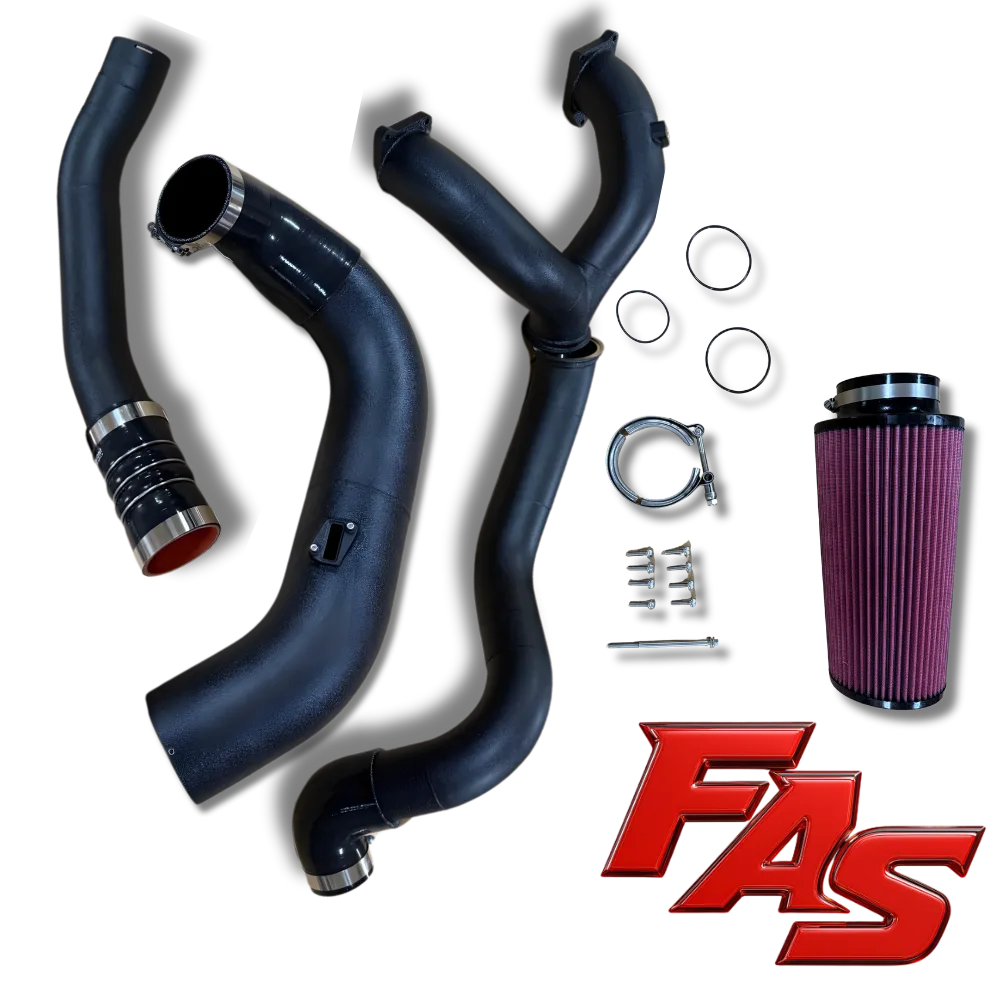
Filter size. Bigger is better, within reason. A 5–6" diameter cone filter with adequate surface area won’t saturate between service intervals, especially in dusty or towing environments. Avoid intakes that use small cone filters to look sporty — they flow less and need cleaning more often.
Heat shielding. The 6.7 Powerstroke engine bay runs hot under tow load. An open-element cone intake without a heat shield will see elevated intake temperatures when you’re pulling a grade. Look for a full or partial heat shield that isolates the filter from radiating engine heat. The best setups draw from the fender well or forward bumper area where air is cooler.
Inlet tube diameter. The OEM tube is restrictive in diameter and routing. Aftermarket tubes typically run 3.5–4" inside diameter — match this to your throttle body inlet to avoid creating a new restriction at the joint.
Filter media. Dry synthetic (like S&B or aFe Dry-S) vs. oiled cotton gauze (K&N, aFe Pro 5R). Oiled media flows slightly better when clean but requires periodic re-oil service and can transfer oil to the MAF sensor if over-oiled. Dry synthetic is lower maintenance and MAF-safe. Either works; dry is the lower-risk choice on a daily driver.
MAF housing fit. The 6.7 Powerstroke uses a mass airflow sensor. The intake tube must seal correctly at the MAF housing or you’ll pull unmetered air and trigger lean codes. Verify the kit you’re buying includes a proper MAF adapter if the geometry requires one.
CAI vs. Intake Manifold: Which First?
For the large majority of 6.7 Powerstroke owners — stock engine, light tow mods, maybe a tune — do the cold air intake first. It’s the highest-leverage pre-turbo improvement available, the installation is DIY in 30–60 minutes, and the cost is significantly lower than manifold work.
For builds targeting maximum airflow:
- Towing / EGT management builds: CAI first. The pre-turbo restriction is the primary EGT driver under sustained load. Getting clean, cool air to the turbo efficiently is the priority.
- High-output performance builds (tuned, larger injectors, compounds): Both. Once you’ve addressed pre-turbo flow and added significant fueling, the post-intercooler intake manifold becomes the next restriction. This is the point where manifold porting or replacement enters the picture.
- Stock-plus daily drivers: CAI alone is sufficient for most builds at this level.
Frequently Asked Questions
Will a cold air intake cause a check engine light on my 6.7 Powerstroke?
A properly fitted CAI with correct MAF sealing won’t trigger codes on a stock tune. Issues arise from poor MAF adapter fit (unmetered air), over-oiled filter media transferring to the MAF sensor, or filter bypass if the housing seal fails. Buy a kit that specifically lists your model year as compatible — not a universal fit.
Does a 6.7 Powerstroke CAI affect my turbo spool?
Marginally yes — removing pre-turbo restriction reduces the delta pressure the turbo has to overcome, which translates to slightly faster spool under hard acceleration. The effect is most noticeable on the street under full throttle pulls; under sustained tow load the benefit shows more in EGT reduction than in spool time.
Can I install a 6.7 Powerstroke cold air intake myself?
Yes. Most quality kits require only basic hand tools and take 30–60 minutes. Remove the factory airbox, swap the inlet tube, mount the filter housing, reconnect the MAF sensor and breather lines, and you’re done. No lifts, no special tools, no calibration required.
Do I need a tune with a cold air intake?
No — a CAI alone doesn’t require a tune on a stock ECU. However, if you’re also running other mods (larger injectors, EGR delete, upgraded intercooler), a tune is required to take full advantage of the improved airflow and keep AFRs correct.
Does a cold air intake void my Ford warranty?
Under the Magnuson-Moss Warranty Act, a dealer cannot void your warranty simply because you installed an aftermarket part. However, if a warranty claim is made on a component the dealer can demonstrate was directly damaged by the aftermarket part (e.g., MAF sensor failure from an over-oiled filter), that specific claim could be denied. For most daily drivers, the risk is minimal.
For the full picture on how the 6.7 Powerstroke intake system works from airbox to cylinder — including where the manifold comes into the equation — see our Powerstroke airflow guide (coming Jul 2). For all FAS Powerstroke performance parts, visit our Powerstroke performance collection.
Related Posts
Hellcat Supercharger Porting Explained: What It Does and When You Need It
If you're pushing a Hellcat, TRX, or Trackhawk past 700 whp, you've probably asked about supercharger porting — here's what it is & if it's right for you.
Hellephant C170 Engine: What It Is, What It Makes, and What It Costs
The Dodge Hellephant C170 crate engine makes 1,000 hp and 950 lb-ft from 426 cubic inches. What it is, what it costs, and what a complete build runs.
LT4 & Hellcat Supercharger Porting: FAS Porting Process, Gains & What It Costs
LT4 (C7 Z06, ZL1), 2.4L Hellcat TVS, and 2.7L IHI supercharger porting done in-house. Precision CNC port work, flow-bench verified, shipped back in 3–5 business days from Punta Gorda, FL.